Cayman Islands company and director search
Search Cayman Islands companies and directors, and read what the General Registry records, what the law makes public, what it keeps private and who can see it.
373,734 companies of the Cayman Islands, from the records of the General Registry of the Cayman Islands.
Searching by name is free. Documents are paid one at a time; no subscription is necessary.
Cayman Islands company documents
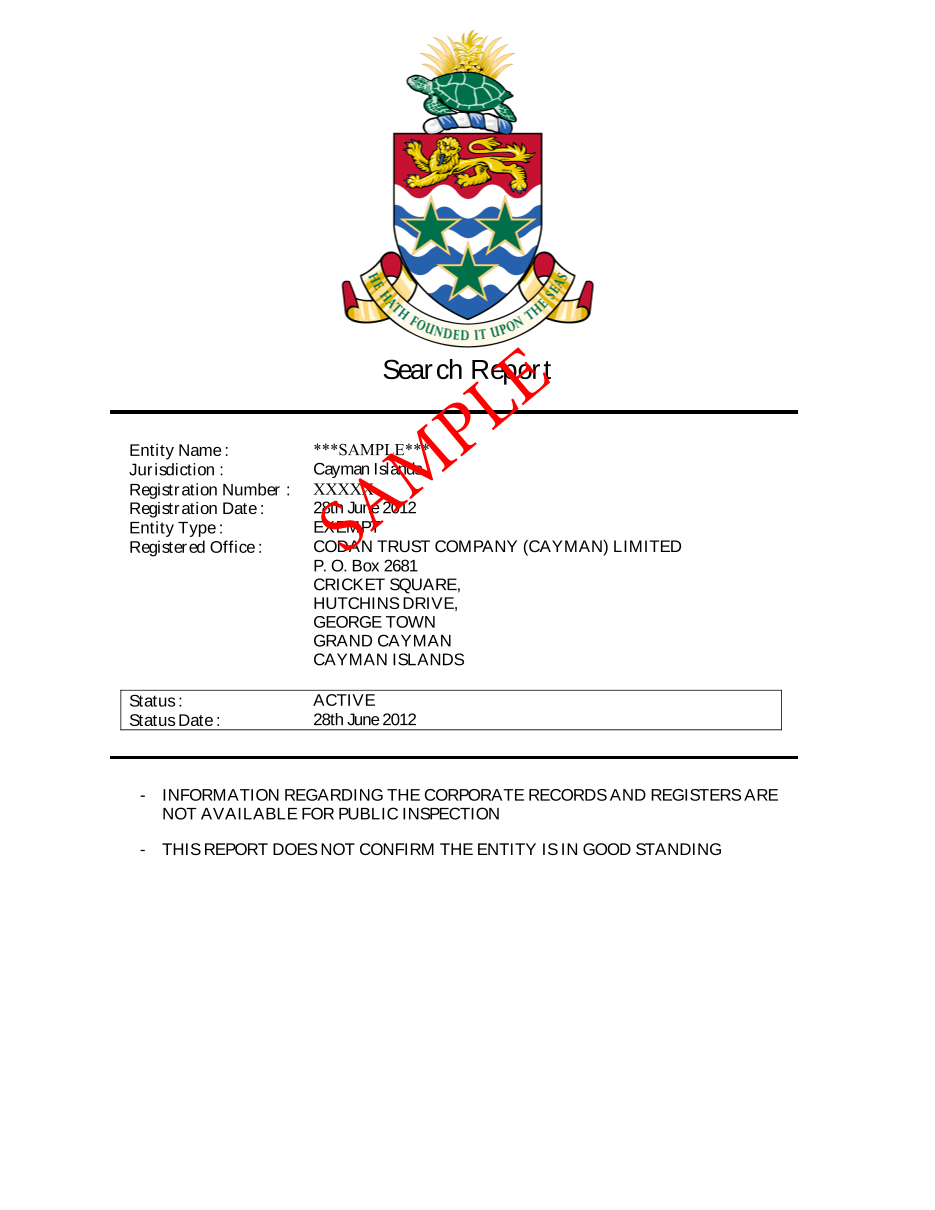
Search the company, or open a document below and choose the company there. Each document page says what it contains and gives the price and the delivery time before you pay, with pages of a real example where we have one.
- Cayman Islands Company Profile
Existence, status, type and registered office.
Electronic PDF by e-mail, within 60 minutes€125View details - Cayman Islands Company Full Report
Cayman Islands full company file with directors.
Electronic PDF by e-mail, up to 4 business days€225View details
Dato Capital is a private company, not the General Registry of the Cayman Islands. A certificate or a copy is a document of the register that we obtain for you; a report is compiled by Dato Capital from the register's records.
Cayman Islands company information at a glance
Each company receives a number from the Registrar of Companies, one of the particulars of the register of companies (company numbers).1 Any person may inspect the register, on payment of a fee and subject to the Registrar's conditions (section 26(3A) of the Companies Act).1
- Public: the name, number, part of the Islands of the registered office, capital, subscribers, dates of the memorandum, nature of business and financial year end; the address of the registered office, on request to the Registrar; the names of the current directors and alternate directors (what is public, directors).1
- Not public: the members of an exempted company that holds no licence in the Islands; the addresses of directors at the Registry (the Registrar's public list gives names only); the company's register of mortgages and charges, open to its creditors and members. Accounts are not filed with the Registrar of Companies. Beneficial ownership information has no open public search: it goes to the authorities, in limited fields to licensed financial institutions and designated businesses, and, in limited fields on application, to persons with a legitimate interest (shareholders, charges and mortgages, financial statements, beneficial owners).1, 8, 11
- Changes: a company files changes with the Registrar within short time limits, such as 30 days for a change of directors and 15 days for a special resolution; each January a company with a share capital sends a copy of its annual list of members or, if it is an exempted company without a licence in the Islands, an annual return (filings).1
- Documents: the Registrar issues the certificate of incorporation, a certificate of good standing on the company's application, and certified copies of filed documents; certificates, other than those of striking off or dissolution, go only to the company's principals or persons they authorise (documents and certificates).1, 37
- Status: the Registrar may strike off a company that is not carrying on business or not in operation, and it is then dissolved; the Registrar publishes the striking off by Government Notice in the Gazette (company status).1
The Registrar of Companies
The register is administered by the Registrar of Companies and staff of the General Registry of the Cayman Islands.28 The Governor appoints a Registrar and a Deputy Registrar of Companies under section 3 of the Companies Act.1
The Registrar keeps a register of companies with the particulars listed in Schedule 1A (section 26(3)).1 The General Registry's online search, for registered users, gives company information such as basic information, the list of directors and a detailed search report summarising the company's constitutional documents.36
The Registrar of Companies also registers limited partnerships (section 48 of the Partnership Act)23 and exempted limited partnerships (section 8 of the Exempted Limited Partnership Act).21
The register stays current through short time limits. A change of directors must reach the Registrar within 30 days (section 55).1 A special resolution must reach the Registrar within 15 days (section 62).1 A new registered office address must be filed within 30 days (section 11).1
The law in force is the Companies Act (2026 Revision), revised as at 1 January 2026. The amendments listed after it on 16 November 2026 are two fee orders and an erratum.1, 29
History
The Companies Act descends from the Companies Law of 1961 (Law 3 of 1961), published as Chapter 22 of the 1963 Revised Edition.1 A company incorporated, and its memorandum recorded, in the Islands before 1 December 1961 is called an existing company (section 2).1
Types of company
One or more persons may form a company, with or without limited liability (section 5 of the Companies Act).1 Liability is limited by shares or by guarantee (section 6).1 A company limited by guarantee may also have a share capital (section 9(3)).1 Share capital may be expressed, and subscribed for, in any one or more currencies (section 8(3)).1
Scroll sideways to see all columns.
| Form | Law | Name must include | What makes it different |
|---|---|---|---|
| Ordinary resident company | Companies Act; Local Companies (Control) Act, section 2(2) | Limited or Ltd. | Carries on business in the Islands. |
| Ordinary non-resident company | Companies Act; Local Companies (Control) Act, section 2(3) | Limited or Ltd. | Designated by the Financial Secretary as not carrying on business in the Islands. |
| Exempted company | Companies Act, Part 7 | Not required | Objects carried out mainly outside the Islands (section 163). May issue shares without par value (section 8). |
| Exempted limited duration company | Companies Act, Part 8 | Limited Duration Company or LDC | At least two members; life of 30 years or less (section 179). |
| Special economic zone company | Companies Act, Part 8A | Special Economic Zone Company or SEZC | An exempted company that carries on special economic zone business (section 182B). |
| Segregated portfolio company | Companies Act, Part 14 | SPC or Segregated Portfolio Company | One legal entity with separate portfolios, each named SP (sections 215 and 216). |
| Foreign company | Companies Act, Part 9 | Its own name | An overseas company with a place of business in the Islands (section 183). |
| Foundation company | Foundation Companies Act | — | No dividends to members; a qualified secretary (section 4). |
| Limited liability company | Limited Liability Companies Act | LLC optional | Formed by a registration statement (section 5). |
| Exempted limited partnership | Exempted Limited Partnership Act | Limited Partnership, L.P. or LP | General partners liable for all debts; limited partners are not (section 4). |
| Limited liability partnership | Limited Liability Partnership Act | LLP optional | Legal personality, but not a body corporate (section 4(4)).22 |
| Limited partnership | Partnership Act | Limited Partnership, L.P. or LP | Registered with the Registrar of Companies (sections 47 and 48; name in section 49A). |
Section 2 of the Companies Act defines both ordinary categories by reference to section 2(2) and (3) of the Local Companies (Control) Act.1, 24 Every company other than an exempted company holds a general meeting each year (section 58).1 Section 7(1)(a) of the Companies Act requires the word Limited or the abbreviation Ltd. as the last word of the name, except for exempted and unlimited companies.1
An exempted company may not trade in the Islands except to further its business outside the Islands, unless it holds a licence (section 174).1 If it is not listed on the Cayman Islands Stock Exchange, it may not invite the public in the Islands to subscribe for its securities (section 175).1
An exempted company may apply for an undertaking that future taxes on profits, income or gains will not apply to it. The undertaking lasts up to 30 years (section 6 of the Tax Concessions Act).27
A foundation company is a company limited by shares or by guarantee; its memorandum states that it is a foundation company (section 4(1) of the Foundation Companies Act).20 An exempted limited partnership needs at least one general partner resident or registered in the Islands (section 4(4) of the Exempted Limited Partnership Act).21 A limited liability company may not carry on business with the public in the Islands, except to further its business outside the Islands (section 9(1) of the Limited Liability Companies Act).19 An exempted limited partnership may not undertake business with the public in the Islands, except so far as necessary for its business outside the Islands (section 4(1) of the Exempted Limited Partnership Act).21
Since 1 January 2026, an exempted company may re-register as an ordinary resident company. A limited liability company or a foundation company may convert into an exempted company (sections 211A, 233A and 233B, added by the Companies (Amendment) Act, 2024).4
Company numbers
Each company receives a number from the Registrar. The number is one of the particulars of the register of companies (Schedule 1A, paragraph (g) of the Companies Act).1 The Act says only that memoranda are numbered and filed consecutively (section 26(2)); it does not set a format.1
A company changes its name by special resolution, and the Registrar issues a certificate of incorporation in the new name (section 31).1 The new name replaces the former name on the register (section 31(2)).1
An exempted company may also carry a dual foreign name. The register enters it only together with a translated name that meets the rules on names (section 30(5)).1 A name may be reserved for up to four months, and the reservation may be renewed by a further application before it expires (section 29A).1
What is public
The table describes the information normally obtainable from the Registrar of Companies and from the records the law opens to inspection. The legal basis gives the law, its section and the year of its current revision; the year of a law does not show when an item first became public.
Scroll sideways to see all columns.
| Item | Public | Legal basis |
|---|---|---|
| Name, number, part of the Islands of the registered office, capital, subscribers, dates of the memorandum, nature of business, financial year end | Yes, by inspection of the register of companies (fee KYD 50) | Companies Act (2026 Revision), section 26(3A) and Schedule 1A1; added by the Companies (Amendment) (No. 2) Law, 202015 |
| Address of the registered office | Yes, on request to the Registrar | Companies Act (2026 Revision), section 51(2)1 |
| Names of current directors and alternate directors | Yes, from the Registrar's list (fee KYD 50) | Companies Act (2026 Revision), section 55A1; added by the Companies (Amendment) Law, 201917 |
| Addresses of directors and officers | Not on the Registrar's public list; for a company that files an annual list of members, in that list, kept with the register of members and open as that register is (fee up to KYD 10) | Companies Act (2026 Revision), sections 41(1)(h), 44(2), 55 and 55A1 |
| Register of members of an ordinary company or a licensed exempted company | Yes, at the registered office (fee up to KYD 10) | Companies Act (2026 Revision), section 44(2)1 |
| Register of members of an exempted company without a licence in the Islands | No public inspection right; the company keeps it where it decides, inside or outside the Islands; the Tax Information Authority can order it produced at the registered office | Companies Act (2026 Revision), section 44(1), (2) and (4)1 |
| Register of mortgages and charges | No public access; open to the company's creditors and members. Charges over registered land are registered under the Registered Land Act | Companies Act (2026 Revision), section 54(3)1; Registered Land Act (2018 Revision), section 64(3)30 |
| Accounts | Not filed with the Registrar of Companies; the company keeps its books of account. A company regulated by the Cayman Islands Monetary Authority may file account information with that Authority under a regulatory law | Companies Act (2026 Revision), section 59(1), (2C)1 |
| Beneficial owners | Restricted, no open public search: the authorities listed in the Act; limited fields for licensed financial institutions and designated businesses; limited fields, on application, for members of the public with a legitimate interest | Beneficial Ownership Transparency Act (2026 Revision), section 228; Beneficial Ownership Transparency (Legitimate Interest Access) Regulations, 2024, regulation 311 |
| Limited liability company registration statement and managers | Yes (fee KYD 50 for the statement) | Limited Liability Companies Act (2025 Revision), sections 5(2A) and 34A19 |
| Exempted limited partnership record and statements | Yes | Exempted Limited Partnership Act (2025 Revision), section 9(2)21 |
| Limited partnership record and statements | Yes | Partnership Act (2025 Revision), section 49(2)23 |
| Register of limited partners of an exempted limited partnership | No public access; open to the partners, and to others with the general partner's consent | Exempted Limited Partnership Act (2025 Revision), section 29(3)21 |
The subscribers listed in the register of companies are those who signed the memorandum, with their addresses and shares (Schedule 1A).1 Inspection is subject to the Registrar's conditions (section 26(3A)).1 Under section 26A, listed authorities, such as the Financial Reporting Authority and the Tax Information Authority, can ask the Registrar in writing for information they need for their functions under the Acts the section lists; the Registrar provides it within 48 hours.1
Directors
Every company keeps a register of the names and addresses of its directors, alternate directors and officers at its registered office (section 55(1) of the Companies Act).1 It sends a copy to the Registrar within 60 days of the first appointment of a director or officer.1 It notifies any change, including a change of name, within 30 days.1
Section 55(2) sets who is registered as an alternate director: a person appointed by a director to exercise all the powers and responsibilities of that director, who is entitled to receive notice of board meetings and to sign written board resolutions, and is considered a director in all respects.1 That rule does not apply to a person appointed for less than 90 days, for particular meetings or resolutions, or with limited powers (section 55(3)).1
A breach costs the company KYD 500 (section 56(1)).1 If the Registrar is satisfied that the breach was knowingly and wilfully authorised or permitted, the company pays a further KYD 1,000, and each director and officer pays KYD 1,000 and KYD 100 for each day the default continues (section 56(3)).1
The Companies Act does not fix a minimum number of directors. Where the model articles in Table A apply to a company limited by shares registered after 1 December 1961, because it has registered no articles or its articles do not exclude or modify them (section 22(2)), a majority of the subscribers fix the number and names of the first directors in writing (Table A, regulation 63), and a director must hold at least one share (regulation 65).1 A body corporate can be a director: the Directors Registration and Licensing Act, 2014 (Law 10 of 2014, as amended in 2015, 2019 and 2023) requires a body corporate appointed as a director of an entity it covers, such as a regulated mutual fund, to be licensed by the Cayman Islands Monetary Authority, unless it holds a companies management or mutual fund administrators licence (sections 2 and 17).31
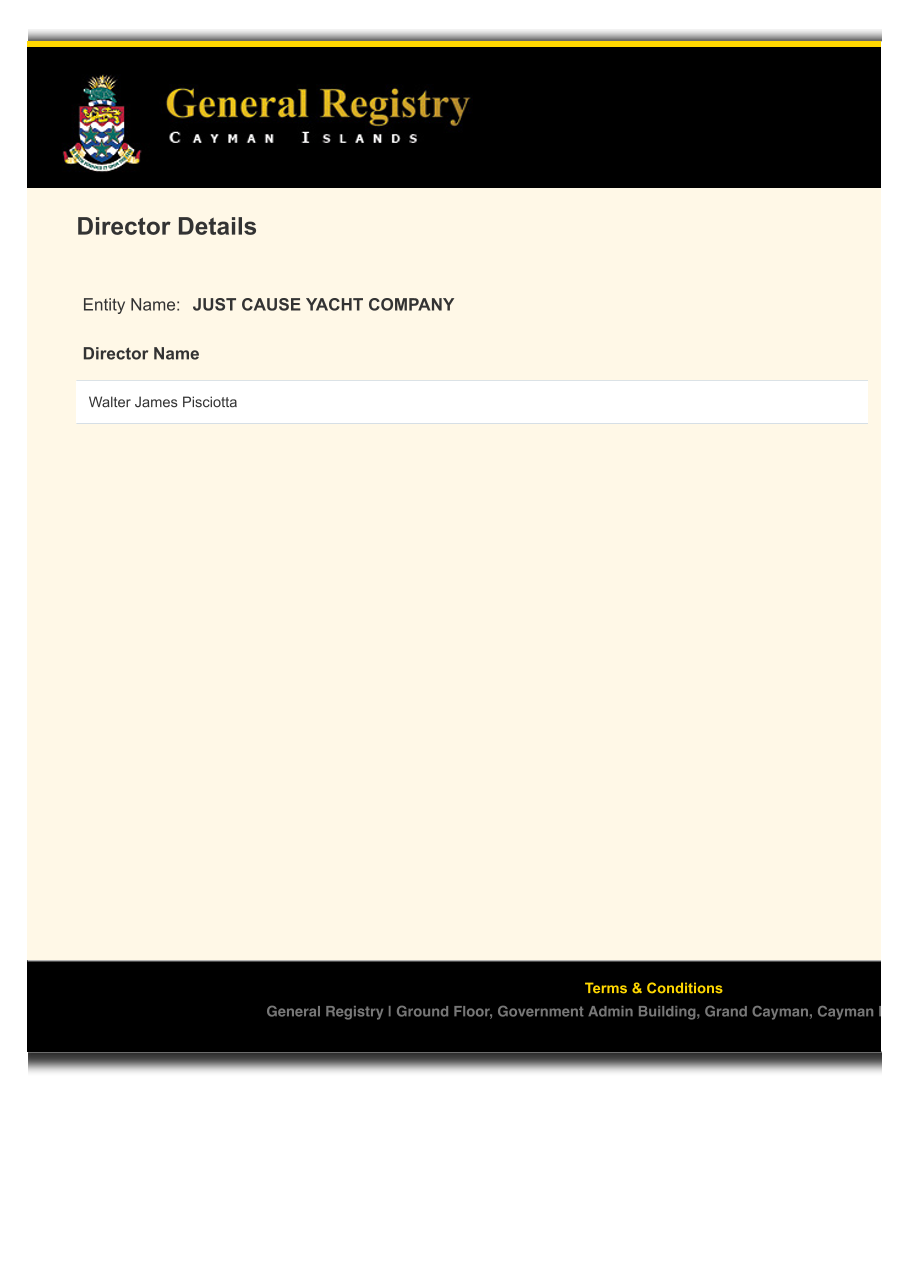
The Registrar keeps a list of the names of the current directors and alternate directors of each company. Any person may inspect it for KYD 50 a time (section 55A and Part 6A of Schedule 5).1 The list holds names only. Addresses and officers are not on it. Section 55 gives the public no right to inspect the register of directors kept at the registered office.1
Section 55A was added by the Companies (Amendment) Law, 2019 (Law 10 of 2019).17 The same law cut the time limit for changes from 60 days to 30 days.17 Its section 5, which created the public list, came into force on 1 October 2019, under a Cabinet order published on 19 September 2019 (SL 34 of 2019).1, 39
For a limited liability company, the Registrar keeps a list of the names of the current managers, open to any person (section 34A of the Limited Liability Companies Act).19
Beneficial owners
The Beneficial Ownership Transparency Act, 2023 has been in force since 31 July 2024.9 The current text is the 2026 Revision.8 It applies to companies, limited liability companies, limited liability partnerships, limited partnerships, foundation companies and exempted limited partnerships (section 3).8
A beneficial owner is an individual who owns or controls, directly or indirectly, 25 per cent or more of the shares, voting rights or partnership interests. An individual who exercises ultimate effective control, or control through other means, is also a beneficial owner (section 4(1)).8 Where a trust meets one of these conditions, a trustee of the trust is identified as the contact person (section 4(3)). Where there is no registrable beneficial owner or trustee, the senior managing official is the contact person (section 4(4)).8
The register is kept by the company's corporate services provider, the licensed firm that provides its registered office (section 13(1)).8 An ordinary resident company without such a provider keeps its own (section 13(2)).8 The provider deposits the information with the competent authority at least once a month (regulation 8 of the Beneficial Ownership Transparency Regulations).10 The competent authority is the Minister responsible for financial services (sections 2 and 5).8
The register records, for an individual, the full name, residential address, date of birth, nationality, identity document details and the nature of control (section 12(5)).8 Listed companies and their subsidiaries, companies licensed under a regulatory law and registered funds give, through their corporate services provider, a written confirmation of their category instead (section 12(1) and (4)).8 Changes are recorded within 30 days (sections 14 and 15).8
There is no open public search. The competent authority keeps a search platform for the police, the Financial Reporting Authority, the Cayman Islands Monetary Authority, the Tax Information Authority and other listed bodies (section 22(2)).8 Licensed financial institutions and designated businesses can see a limited set of fields (section 22(2A)) for KYD 1,500 a user a year.8, 10
Members of the public can apply under the Beneficial Ownership Transparency (Legitimate Interest Access) Regulations, 2024, in force since 28 February 2025.11 Three groups qualify (regulation 3): persons engaged in journalism or academic research, civil society organisations that fight money laundering, and persons in a potential or actual business relationship or transaction with the legal person.11 The applicant must show a legitimate interest in preventing or combating money laundering, its predicate offences or terrorist financing.11 An application must name a legal person: no search on an individual's name is permitted.38
The fee is KYD 75 for one legal person, KYD 100 for connected legal persons and KYD 250 for multiple applications in one year. The 2026 amendment regulations, published on 18 March 2026, raised the single fee from KYD 30.12 The authority sends its decision with the information, or with reasons for a refusal, within seven working days of deciding (regulation 5(2)).11
Even then, for an individual the public may receive only name, country of residence, nationality, month and year of birth and nature of control; nothing about a minor (section 22(6)).8 An individual at serious risk of kidnapping, extortion, violence or intimidation can ask that nothing about them be disclosed to the public. An approval lasts three years (regulations 3 and 4 of the Access Restriction Regulations).13
The earlier regime was Part XVIIA of the Companies Act, with the Beneficial Ownership (Companies) Regulations in force from 1 July 2017.29 Under it, the company's corporate services provider kept the beneficial ownership register and the competent authority could search it; an ordinary resident company could instead engage the Registrar to help it keep its register (sections 252 and 262 as amended in 2020).16 In 2020 its threshold changed from more than 25 per cent to 25 per cent or more.16 The Companies (Amendment) Act, 2023 repealed Part XVIIA from 31 July 2024.6, 7
A breach can bring an administrative fine of KYD 5,000, and KYD 1,000 a month while it continues, up to KYD 25,000 in total (section 26).8 The Beneficial Ownership Transparency (Administrative Fines) Rules, 2026, published on 29 October 2026, treat these amounts as maximums: the Registrar may impose a lesser amount, starting from the seriousness of the breach (rules 4 and 5); they apply to breaches occurring on or after their commencement (rule 1(2)). The Registrar may publish a fine, once the appeal period has passed or any appeal is decided, in the Gazette and on the General Registry website (rule 14).35 A company that leaves a fine unpaid for 90 days can be struck off (section 156A of the Companies Act).1
Financial statements
Every company keeps proper books of account that give a true and fair view of its affairs, with the underlying contracts and invoices (section 59(1) and (2) of the Companies Act).1 It keeps them for at least five years (section 59(3)).1 A knowing and wilful breach costs KYD 5,000 (section 59(4)).1
The Companies Act does not require a company to file accounts with the Registrar. Accounts are therefore not on the public register. There are no size classes or abridged accounts in the Act.1
A company that keeps its books outside the Islands must send information about them to its registered office (section 59(2B)).1 The Tax Information Authority can order copies to be produced there (section 59(2A)).1 A company that files account information with the Cayman Islands Monetary Authority under a regulatory law is outside section 59(2B) (section 59(2C)).1
A relevant entity that carries on a relevant activity and must meet the economic substance test sends a report to the Tax Information Authority within 12 months after the end of each financial year (section 7(3) of the International Tax Co-operation (Economic Substance) Act).26 The report includes the relevant activity, its income, expenses and assets, the place of business in the Islands and the number of employees (section 7(4)). It is not filed with the Registrar.26
Filings
Scroll sideways to see all columns.
| Filing | What it reports | Time limit | Law |
|---|---|---|---|
| Memorandum and articles of association | Incorporation; an exempted company adds a declaration that it will operate mainly outside the Islands | Before registration | Companies Act, sections 26 and 165 |
| Name reservation | Reserves a name | Up to four months, renewable | Companies Act, section 29A |
| Notice of registered office | Where the office is; the Registrar records it and it is published by Public Notice | None in section 51; until notice is given and published, the company is not deemed to have complied with the Act as to having a registered office. The General Registry lists a company for striking off after 30 days without notice of the appointment of a registered office.37 | Companies Act, section 51(1) |
| Change of registered office | Directors' resolution with the new address | 30 days | Companies Act, section 11 |
| Register of directors and officers | Names and addresses | 60 days after the first appointment | Companies Act, section 55(1)(a) |
| Change of directors or officers | Appointments, departures, changes of name | 30 days | Companies Act, section 55(1)(b) |
| Special resolution | Changes to the memorandum or articles, change of name | 15 days | Companies Act, sections 31 and 62 |
| Notice of increase of capital | New capital or new number of members | 30 days | Companies Act, section 45 |
| Solvency statement and minute of reduction | Reduction of capital without the court | 15 days | Companies Act, section 14B |
| Annual list of members and summary (copy), with the annual fee | Members, shares, directors and officers, nature of business (companies with a share capital other than exempted companies without a licence in the Islands; the annual fee under section 41(2) is paid by every company other than an exempted company) | January | Companies Act, sections 41 and 42 |
| Annual return, with the annual fee | Declaration of an exempted company without a licence in the Islands; every exempted company pays the annual fee | January | Companies Act, sections 168 and 169 |
| Notice of segregated portfolios | Portfolios created and terminated | With the annual fee | Companies Act, section 213(6) |
| Notice of voluntary winding up | Liquidation, liquidator's consent and, if the court's supervision is not sought, the directors' declaration of solvency; filed by the liquidator or, without one, the directors | 28 days | Companies Act, section 123 |
| Liquidator's return | Final meeting | 7 days after the meeting | Companies Act, section 127(3) |
| Dissolution order | Dissolution by the court; filed by the official liquidator | 14 days after the order is perfected | Companies Act, section 152(3) and (4) |
| Registration of a foreign company | Certificate of incorporation, good standing, constitution, directors, agent for service | One month | Companies Act, section 184(1) |
| Return of alterations of a foreign company | Changes to the filed documents | 30 days | Companies Act, section 187 |
A late annual list of members, annual return or annual fee carries a penalty. It is 33.33 per cent of the annual fee from 1 April, 66.67 per cent from 1 July and 100 per cent from 1 October (sections 42 and 169(3)).1 An exempted company that does not file is treated as defunct, after one month's notice (sections 170 and 171).1
The annual fees change on 1 January 2027 under the Companies (Amendment of Schedule 5) (No. 2) Order, 2026. The smallest exempted company will pay KYD 1,025 instead of KYD 925; a foreign company KYD 1,750 instead of KYD 1,650.2 That order repealed an earlier 2026 order before it took effect; the earlier order had also raised the fees of ordinary resident companies.2, 3
Documents and certificates
- Certificate of incorporation. The Registrar issues it when the memorandum is filed. It states the date of incorporation and, for a limited company, that the company is limited (section 27(1) of the Companies Act).1
- Certificate of good standing. Issued on the company's application. It is evidence that, on the date of issue, all fees and penalties are paid and the Registrar knows of no default (section 200A).1 The fee for a certificate is KYD 150 (Schedule 5, Part 6).1 The General Registry sets no expiry date and suggests 30 days from the date of issue; the receiving institution decides how recent it must be.37
- Inspection of the register of companies. It shows the Schedule 1A particulars for KYD 50 (section 26(3A)). The general search fee is KYD 30 (Schedule 5, Part 6).1
- List of directors. The names of the current directors and alternates, KYD 50 an inspection (section 55A).1
- Certified copies. The Registrar provides copies of filed documents for KYD 150 per folio of 72 words, and certifies them for KYD 150 (Schedule 5, Parts 6 and 8).1 A certified copy can be ordered for documents such as the memorandum and articles or special resolutions.
- Certificate of registration of a foreign company. Conclusive evidence that the foreign company has complied with registration (section 186).1
- Customised certificates and letters requested by a company (section 199A and Schedule 5, Part 8).1
An express service completes a transaction the same working day if the request and fees arrive by noon (section 200).1 The General Registry issues certificates, other than those of striking off or dissolution, only to the company's principals or persons they authorise. Each certificate shows an authentication code, a website address and its date of issue, by which it can be verified online.37 For a resident (local) company, the General Registry offers certificates of good standing, of incorporation, of existence, of incumbency (directors and officers) and of shareholders. The status of a company, such as active or dissolved, can be determined from a search report or a certificate of existence.37
For use abroad, a document can carry an apostille under the Hague Convention of 5 October 1961. The Hague Conference lists the Passport and Corporate Services Office as the competent authority for the Cayman Islands, among the authorities of the United Kingdom.33 An apostille certifies the authenticity of the signature, the capacity in which the signer acted and, where appropriate, the identity of the seal or stamp (articles 3 and 5 of the Convention).32 The office keeps an electronic register: an apostille issued in the Cayman Islands on or after 10 February 2023 can be verified online, as the Government announced on 22 August 2023.34
Charges and mortgages
The Companies Act does not provide for charges to be filed with the Registrar of Companies. Every limited company keeps its own register of all mortgages and charges specifically affecting its property, at its registered office (section 54(1) of the Companies Act).1 Each entry gives a short description of the property, the amount and the names of the persons entitled to the charge.1
The Act opens this register to inspection by any creditor or member of the company (section 54(3)).1 If inspection is refused, a judge may order an immediate inspection (section 54(3)).1 A director, manager or officer who knowingly and wilfully allows a charge to go unentered pays KYD 100 (section 54(2)).1
Some security is registered elsewhere: a charge over registered land is completed by its registration as an incumbrance under the Registered Land Act (section 64(3)).30 A search of the company register may not show all charges over a company's assets.
Company status
The Registrar may strike off a company that is not carrying on business or not in operation; it is then dissolved (section 156 of the Companies Act).1 A company may request its own striking off for a fee of KYD 75 (section 156(2)).1 A company in liquidation with no liquidator acting can also be struck off (section 157).1
Every striking off is published in the Gazette with its date and reason (section 158).1 The liability of directors, managers, officers and members continues (section 160).1 The company's property vests in the Minister responsible for finance (section 162).1 The General Registry does not make the records of a company removed from the register available to the public; the exceptions include a court order and a request from a law enforcement agency.37
The company, a member or a creditor may apply to the court for restoration within two years of striking off. With the Cabinet's leave, the limit is ten years (section 159).1 The restoration fee is twice the original registration fee. A restored company is treated as never struck off.1 This rule was set by the Companies (Amendment and Validation) Act, 2024, in force on 1 January 2025.5, 1
A voluntary winding up starts with a special resolution, or with an ordinary resolution if the company cannot pay its debts (section 116).1 Within 28 days the liquidator, or without one the directors, files notice with the Registrar and publishes it in the Gazette (section 123).1 Without a declaration of solvency, the liquidator must seek the court's supervision (section 124).1 After the final meeting the liquidator files a return within seven days. The company is dissolved three months after the Registrar registers it (sections 127 and 151).1
The court can also wind up a company and orders its dissolution at the end (section 152).1 It can also appoint a restructuring officer (section 91B).1
An exempted company can leave by continuation to another jurisdiction and be deregistered (section 206).1 A body corporate with limited liability from outside the Islands can arrive the same way, as an exempted company limited by shares (section 201).1
Legislation
Scroll sideways to see all columns.
| Law in force | Original act | What it governs |
|---|---|---|
| Companies Act (2026 Revision) | Law 3 of 1961 | Companies, the register, winding up |
| Beneficial Ownership Transparency Act (2026 Revision) | Act 13 of 2023 | Beneficial ownership registers |
| Limited Liability Companies Act (2025 Revision) | Law 2 of 2016 | Limited liability companies |
| Foundation Companies Act (2025 Revision) | Law 29 of 2017 | Foundation companies |
| Exempted Limited Partnership Act (2025 Revision) | Law 5 of 2014 | Exempted limited partnerships |
| Limited Liability Partnership Act (2025 Revision) | Law 13 of 2017 | Limited liability partnerships |
| Partnership Act (2025 Revision) | Law 26 of 1983 | Partnerships and limited partnerships |
| Local Companies (Control) Act (2025 Revision) | Law 24 of 1971 | Resident and non-resident companies, trade licences |
| International Tax Co-operation (Economic Substance) Act (2026 Revision) | Law 45 of 2018 | Economic substance |
| Tax Concessions Act (2018 Revision) | Chapter 164 | Tax undertakings |
Timeline
- 1961: the Companies Law (Law 3 of 1961), later Chapter 22.1
- 26 April 2001: the Companies (Amendment) (Control of Bearer Shares) Law, 2001.1
- 10 January 2013: the registered office of an exempted or non-resident company must be at the address of its licensed company manager, unless it was already at another address in the Islands before that date and stays there (section 50(2)).1
- 1 July 2017: beneficial ownership registers under Part XVIIA and the Beneficial Ownership (Companies) Regulations, 2017.29
- 1 October 2019: the Registrar's list of directors opens to any person.17, 39
- 2020: the beneficial ownership threshold becomes 25 per cent or more; the register of companies opens to inspection (Law 4 and Law 19 of 2020).16, 15
- 3 December 2020: the Laws of the Islands are cited as Acts (Citation of Acts of Parliament Act, 2020, sections 3 and 4).1, 40
- 1 March 2021: bearer shares prohibited.14, 1
- 31 August 2022: the Companies (Amendment) Act, 2021 comes into force (section 94(2A) refers to that date).18, 1
- 31 July 2024: the Beneficial Ownership Transparency Act, 2023 replaces Part XVIIA.9, 7
- 1 January 2025: name reservation, new restoration periods and express fees (Act 11 of 2024).5, 1
- 28 February 2025: legitimate interest access to beneficial ownership information.11
- 1 January 2026: reduction of capital by solvency statement, re-registration and conversions (Act 3 of 2024).4, 1
- 29 January 2026: the Companies Act (2026 Revision) and the Beneficial Ownership Transparency Act (2026 Revision) published.1, 8
- 18 March 2026: new fees for legitimate interest access.12
- 28 October 2026: the Local Companies (Control) (Amendment) Act, 2026 published; it lets the Cabinet place a moratorium on the grant of licences under that Act and comes into force on a date appointed by Order.25
- 29 October 2026: the Beneficial Ownership Transparency (Administrative Fines) Rules, 2026 published.35
- 1 January 2027: new annual fees.2
Questions
How do I find a company in the Cayman Islands?
The Registrar of Companies at the General Registry of the Cayman Islands keeps the register of companies. Any person may inspect it for KYD 50, subject to the Registrar's conditions (section 26(3A) of the Companies Act). It shows the name, number, the part of the Islands where the registered office is, the capital, subscribers, nature of business and financial year end. The General Registry's online search is for registered users.
Can I see the directors of a Cayman Islands company?
Yes, their names. Since 1 October 2019 the Registrar of Companies keeps a list of the current directors and alternate directors of each Cayman Islands company, open to any person for KYD 50 (section 55A of the Companies Act). Addresses are not on the list.
Are shareholders of a Cayman Islands company public?
It depends on the type. The register of members of an ordinary Cayman Islands company, or of an exempted company with a licence in the Islands, is open to any person at its registered office for up to KYD 10; that of an exempted company without a licence in the Islands is not (section 44(2) of the Companies Act). The register of companies kept by the Registrar of Companies shows the subscribers to the memorandum, not later members.
Is there a public register of beneficial owners in the Cayman Islands?
There is no open public search. Under the Beneficial Ownership Transparency Act, Cayman Islands beneficial ownership information is open to the listed authorities, in limited fields to licensed financial institutions and designated businesses, and, since 28 February 2025, in limited fields on application to journalists, researchers, civil society organisations and business counterparties with a legitimate interest in fighting money laundering or terrorist financing. The fee for one legal person is KYD 75.
Do Cayman Islands companies file accounts?
Not with the Registrar of Companies. A Cayman Islands company keeps books of account for at least five years (section 59 of the Companies Act); the Act does not require it to file accounts with the Registrar. A company regulated by the Cayman Islands Monetary Authority may have to file account information with that Authority under a regulatory law (section 59(2C)).
What is an exempted company in the Cayman Islands?
A Cayman Islands company whose objects are carried out mainly outside the Islands (section 163 of the Companies Act). Without a licence in the Islands, it files a yearly declaration with the Registrar of Companies, not a list of members. It need not use Limited in its name and may not trade in the Islands except to further its business outside the Islands, unless it holds a licence (sections 7(1)(a) and 174).
How do I get a certificate of good standing for a Cayman Islands company?
The company applies to the Registrar of Companies of the Cayman Islands; the General Registry issues it only to the company's principals or persons they authorise. The certificate is evidence that on its date all fees and penalties under the Companies Act were paid and the Registrar knew of no default (section 200A of the Companies Act). It has no expiry date; the General Registry suggests 30 days from the date of issue, and the receiving institution decides how recent it must be.
Does the Cayman Islands have a register of charges?
Not at the Registrar of Companies. Each Cayman Islands limited company keeps its own register of mortgages and charges at its registered office, open to inspection by its creditors and members (section 54 of the Companies Act). A charge over registered land is registered under the Registered Land Act (section 64(3)), so a company register search may not show all charges.
What happens when a Cayman Islands company is struck off?
The Registrar of Companies publishes the striking off in the Gazette and the Cayman Islands company is dissolved (sections 156 and 158 of the Companies Act). The company, a member or a creditor can ask the court to restore it within two years, or up to ten years with the Cabinet's leave (section 159).
Can a Cayman Islands company have bearer shares?
No. Since 1 March 2021 a Cayman Islands company may not issue bearer shares, and bearer shares issued before then are void (section 229 of the Companies Act).
Sources
- Companies Act (2026 Revision), revised as at 1 January 2026, with its endnotes; sections 2–62, 91B, 94, 116–162, 163–216, 229, 233A, 233B, Schedules 1 (Table A), 1A and 5. Read on 27 November 2026.
- Companies (Amendment of Schedule 5) (No. 2) Order, 2026 (SL 46 of 2026), paragraphs 1–3. Read on 27 November 2026.
- Companies (Amendment of Schedule 5) Order, 2026 (SL 38 of 2026), repealed. Read on 27 November 2026.
- Companies (Amendment) Act, 2024 (Act 3 of 2024), sections 5, 12 and 15. Read on 16 November 2026.
- Companies (Amendment and Validation) Act, 2024 (Act 11 of 2024), sections 2–5. Read on 16 November 2026.
- Companies (Amendment) Act, 2023 (Act 15 of 2023), section 4. Read on 16 November 2026.
- Companies (Amendment) Act, 2023 (Commencement) Order, 2024 (SL 17 of 2024). Read on 16 November 2026.
- Beneficial Ownership Transparency Act (2026 Revision), sections 2–16, 22–26. Read on 27 November 2026.
- Beneficial Ownership Transparency Act, 2023 (Commencement) Order, 2024 (SL 16 of 2024). Read on 16 November 2026.
- Beneficial Ownership Transparency Regulations (2026 Revision), regulations 8 and 32, Schedule 3. Read on 16 November 2026.
- Beneficial Ownership Transparency (Legitimate Interest Access) Regulations, 2024 (SL 47 of 2024), regulations 1–6. Read on 27 November 2026.
- Beneficial Ownership Transparency (Legitimate Interest Access) (Amendment) Regulations, 2026 (SL 8 of 2026), regulation 2. Read on 16 November 2026.
- Beneficial Ownership Transparency (Access Restriction) Regulations, 2024 (SL 42 of 2024), regulations 3–5. Read on 16 November 2026.
- Companies (Amendment) (No. 3) Act, 2020 (Act 60 of 2020), section 5. Read on 27 November 2026.
- Companies (Amendment) (No. 2) Law, 2020 (Law 19 of 2020), sections 3, 4 and 16. Read on 16 November 2026.
- Companies (Amendment) Law, 2020 (Law 4 of 2020), sections 6–8. Read on 27 November 2026.
- Companies (Amendment) Law, 2019 (Law 10 of 2019), Supplement No. 1, Legislation Gazette No. 28 of 8 August 2019, sections 1, 4, 5 and 9 (copy published by the Cayman Islands Monetary Authority; not found on legislation.gov.ky on 18 November 2026). Read on 18 November 2026.
- Companies (Amendment) Act, 2021 (Commencement) Order, 2022 (SL 28 of 2022). Read on 16 November 2026.
- Limited Liability Companies Act (2025 Revision), sections 5, 6, 9 and 34A. Read on 27 November 2026.
- Foundation Companies Act (2025 Revision), sections 4 and 5. Read on 27 November 2026.
- Exempted Limited Partnership Act (2025 Revision), sections 4, 6, 8, 9 and 29. Read on 27 November 2026.
- Limited Liability Partnership Act (2025 Revision), sections 4 and 8. Read on 16 November 2026.
- Partnership Act (2025 Revision), sections 47–49A. Read on 16 November 2026.
- Local Companies (Control) Act (2025 Revision), section 2. Read on 16 November 2026.
- Local Companies (Control) (Amendment) Act, 2026 (Act 23 of 2026), sections 1 and 3. Read on 16 November 2026.
- International Tax Co-operation (Economic Substance) Act (2026 Revision), section 7. Read on 27 November 2026.
- Tax Concessions Act (2018 Revision), section 6. Read on 16 November 2026.
- General Registry of the Cayman Islands, Companies Register, the register's overview page. Read on 18 November 2026.
- Cayman Islands legislation by title, versions in force on 16 November 2026 and their amendments (Companies Act, Beneficial Ownership (Companies) Regulations, the acts listed above). Read on 16 November 2026.
- Registered Land Act (2018 Revision) (published as the Registered Land Law (2018 Revision)), section 64. Read on 16 November 2026.
- Directors Registration and Licensing Act, 2014 (Law 10 of 2014) (published as the Directors Registration and Licensing Law, 2014), Supplement No. 6, Extraordinary Gazette No. 35 of 21 May 2014, sections 2 and 17; no consolidated revision published; amended by Law 5 of 2015 (section 27, Schedule), Law 7 of 2019 (definition of covered entity, paragraph (a)) and Act 3 of 2023 (section 2 definitions, section 28), none of which changes the provisions cited. Read on 16 November 2026.
- Hague Conference on Private International Law, Convention of 5 October 1961 Abolishing the Requirement of Legalisation for Foreign Public Documents, articles 3, 5 and 6. Read on 16 November 2026.
- Hague Conference on Private International Law, United Kingdom – Competent Authority (Art. 6), entry for the Cayman Islands. Read on 27 November 2026.
- Radio Cayman (Cayman Islands Government), "Verify Cayman apostille online", 22 August 2023. Read on 16 November 2026.
- Beneficial Ownership Transparency (Administrative Fines) Rules, 2026 (SL 47 of 2026), Legislation Gazette No. 52 of 29 October 2026; rules 1, 2, 4, 5 and 14. Read on 27 November 2026.
- General Registry of the Cayman Islands, Online Tools, section "Online Payments and Services", page updated 14 April 2026. Read on 18 November 2026.
- General Registry of the Cayman Islands, FAQs, answers "Who can request a certificate for a company?", "How long is a certificate of good standing valid (good for)?", "How can I determine the authenticity of a certificate?", "If a company is removed from the register (struck/de-registered/dissolved) are the list of directors and other documents available?", "Which certificates are available to resident (local) companies?", "Is the certificate of good standing the only document that confirms the status of a company?" and "What are the consequences for not having a registered office?". Read on 27 November 2026.
- General Registry of the Cayman Islands, Instructions: Beneficial Ownership Legitimate Interest Access, updated April 2026, note 1. Read on 18 November 2026.
- Companies (Amendment) Law, 2019 (Commencement of Section 5) Order, 2019 (SL 34 of 2019), Supplement No. 1, Legislation Gazette No. 34 of 19 September 2019, paragraph 2 (copy of the gazette supplement published by the Truman Bodden Law School). Read on 18 November 2026.
- Citation of Acts of Parliament Act, 2020 (Law 56 of 2020) (published as the Citation of Acts of Parliament Law, 2020), Supplement No. 1, Legislation Gazette No. 89 of 8 December 2020, sections 3 and 4. Read on 27 November 2026.
New in the register
This guide was reviewed on 27 November 2026 against the laws in its sources list. It is general information and not legal advice. Dato Capital is a private company; it is not the General Registry of the Cayman Islands and does not act for it.